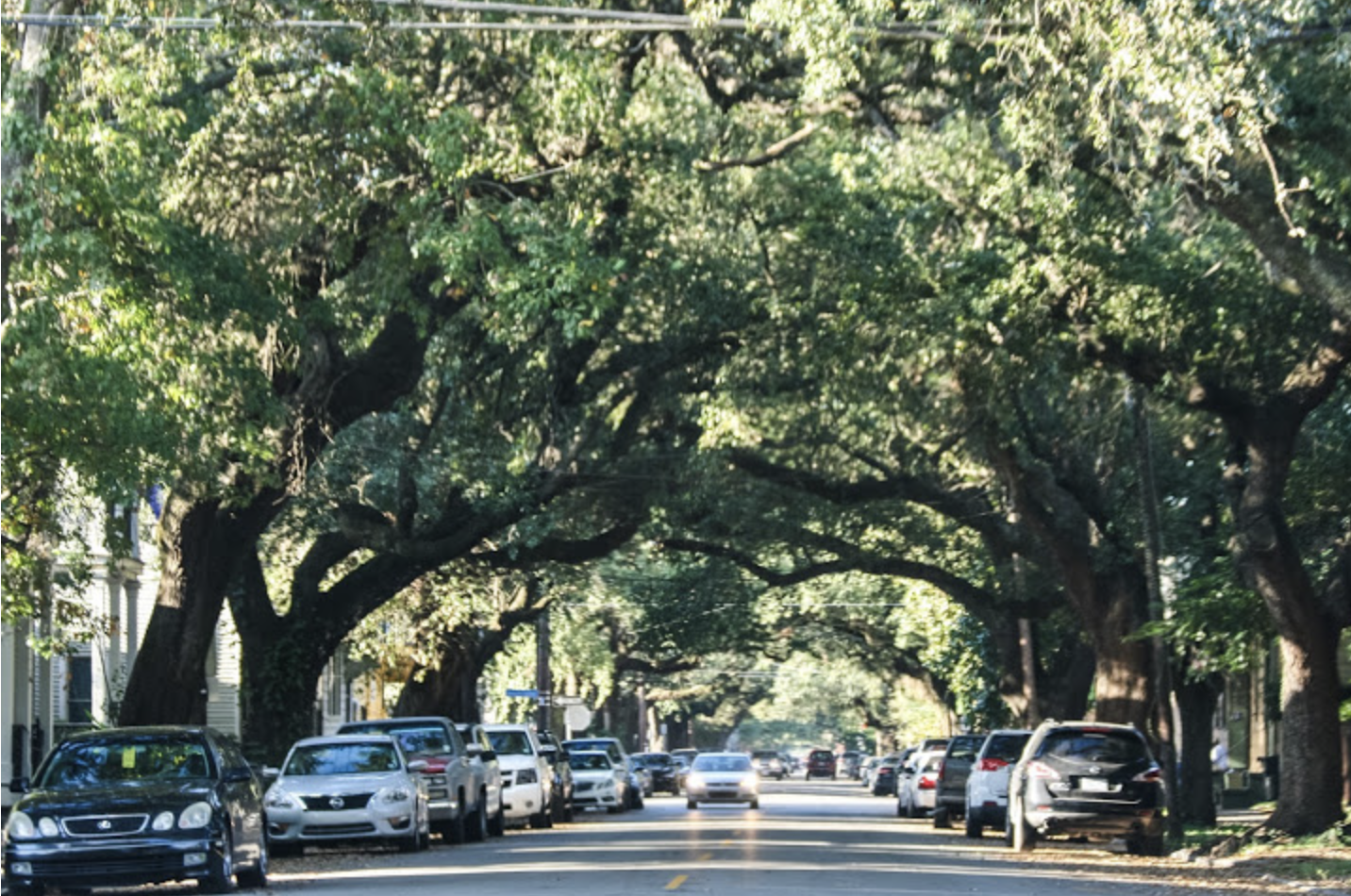
New Orleans loves its trees. We write songs about them. We name streets after them. And in summer, we depend on them because shade is as much a survival strategy as it is a scenic bonus.
That’s why there was so much local energy around a major federal grant that would’ve funded tree planting in underserved neighborhoods like the Lower 9th Ward. While that grant has since been canceled, the conversation it sparked is still worth having. Because building a resilient city means thinking not just about how we plant trees, but how we make them work with the systems that power our lives.
The Tree-Limb Tangle
In many New Orleans neighborhoods, the beauty of our urban canopy is tangled, sometimes literally with our overhead wires. Tree species across the city include small ornamentals up to mature oaks that average a height between 30-50 feet, with limbs that sprawl even wider. Meanwhile, most standard utility poles top out around 35 to 45 feet. You don’t need a ruler to do the math: we’ve built a grid that sits squarely in the crosshairs of our trees.
The result? Storms bring down limbs, which bring down wires, which knock out power — and then the blame game begins. Residents understandably resist aggressive trimming, while utilities get hit for poor reliability. It’s a frustrating cycle that makes no one happy and leaves everyone in the dark.
The Case for Taller Composite Poles
Here’s the good news: we don’t have to choose between reliable electricity and a thriving tree canopy. We can build for both if we’re willing to think vertically.
Composite utility poles, made from resilient materials like fiberglass or polymer resin, offer a powerful solution. Unlike traditional wooden poles, which cap out around 45 feet for distribution systems (lines and poles in our neighborhoods), composite poles can safely and affordably reach 60 to 80 feet, tall enough to rise above even mature oak trees.
They’re also:
- Stronger in storms, withstanding hurricane-force winds better than wood
- Resistant to rot, pests, and corrosion, which is ideal for New Orleans’ wet climate
- Lighter, making them easier to transport and install, even in hard-to-access areas
- Longer lasting, with lifespans of 80+ years
In short: they’re built for the future we’re headed for, one that is hotter, wetter, more storm-prone Gulf South.
Planning With, Not Against, Nature
We’re lucky to have incredible local organizations like SOUL and NOLA Tree Project leading efforts to green the city. The job of energy planners, utilities, and policymakers is to ensure the grid can keep up.
That doesn’t mean cutting down trees — it means designing around them:
- Use taller composite poles in areas with legacy trees
- Encourage smart planting of lower-height species beneath power corridors
- Build coordination between forestry and utility teams from the start
This isn’t just about saving money on storm repairs. It’s about building a city where beauty and reliability coexist and where infrastructure is designed to reflect the landscape it serves.
Resilience Is in the Details
In New Orleans, resilience is more than a buzzword, it’s a necessity. And it’s made up of a thousand little decisions: where we plant, how we build, and whether we’re willing to rethink legacy systems that no longer work.
We’ll keep advocating for clean, reliable, and equitable energy solutions. And in this case, that means poles tall enough to let our trees do what they do best: cool, calm, and connect our communities.